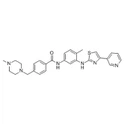
Hey there, fellow pet lovers and veterinary enthusiasts! As a supplier of Toceranib with the CAS number 356068 - 94 - 5, I'm super stoked to dive deep into the chemical properties of this amazing compound. Toceranib has been making waves in the veterinary world, and understanding its chemical nature is key to appreciating its potential.
First off, let's talk about the basic chemical structure of Toceranib. It's a small - molecule tyrosine kinase inhibitor. Tyrosine kinases are enzymes that play a crucial role in cell signaling pathways. By inhibiting these kinases, Toceranib can interfere with the growth, proliferation, and survival of cancer cells.
The molecular formula of Toceranib is C₂₁H₂₃N₅O₂. This tells us that it's made up of 21 carbon atoms, 23 hydrogen atoms, 5 nitrogen atoms, and 2 oxygen atoms. Just looking at this formula, we can start to understand some of its chemical behavior. Carbon atoms are the backbone of organic compounds, and they form strong covalent bonds with other atoms. The hydrogen atoms are often involved in hydrogen bonding, which can affect the compound's solubility and reactivity.
One of the important chemical properties of Toceranib is its solubility. It's sparingly soluble in water but more soluble in organic solvents like DMSO (dimethyl sulfoxide). This solubility profile is important for its formulation into drugs. Since it doesn't dissolve well in water, special techniques are needed to make it suitable for administration to animals. For example, it can be formulated as a suspension or in a lipid - based delivery system.
Toceranib is also relatively stable under normal storage conditions. It has a melting point in the range that allows it to be processed into solid dosage forms, such as tablets. This stability is crucial for ensuring the quality and efficacy of the drug over time. However, like any chemical, it can be affected by factors such as temperature, humidity, and light. So, proper storage in a cool, dry, and dark place is recommended.
In terms of its reactivity, Toceranib can undergo chemical reactions typical of amines and amides, which are functional groups present in its structure. Amines can react with acids to form salts, and this property can be used to improve the solubility and bioavailability of the compound. For example, Toceranib phosphate is a common salt form that is used in veterinary drugs. The phosphate group can increase the water solubility of Toceranib, making it easier to administer.


Another interesting aspect of Toceranib's chemical properties is its interaction with biological molecules. As a tyrosine kinase inhibitor, it binds specifically to the active site of certain kinases. This binding is based on the complementary shape and chemical properties of Toceranib and the kinase. The interaction is reversible, which means that Toceranib can dissociate from the kinase after it has exerted its inhibitory effect.
Now, let's compare Toceranib with some other veterinary compounds. For example, Altrenogest CAS 850 - 52 - 2 is a progestin used in veterinary medicine for estrus synchronization in livestock. Its chemical structure and properties are quite different from Toceranib. Altrenogest is a steroid, and it acts by binding to progesterone receptors, while Toceranib targets tyrosine kinases.
Sarolaner CAS No.: 1190865 - 44 - 1 is an ectoparasiticide used to control fleas and ticks on dogs. It has a different mode of action compared to Toceranib. Sarolaner acts on the nervous system of parasites, while Toceranib is focused on cancer cell signaling.
Pimobendan is a positive inotrope and vasodilator used in the treatment of heart failure in dogs. It works by increasing the contractility of the heart muscle and dilating blood vessels. Again, its chemical properties and mechanism of action are distinct from Toceranib.
As a supplier of Toceranib, I understand the importance of providing high - quality products. We ensure that our Toceranib meets strict quality control standards. Our manufacturing process is carefully monitored to ensure the purity and consistency of the compound. We also offer technical support to our customers, helping them with any questions regarding the chemical properties and formulation of Toceranib.
If you're a veterinary pharmaceutical company, a research institution, or a veterinarian interested in using Toceranib in your work, I'd love to hear from you. Whether you're looking to develop a new drug formulation or conduct research on its mechanism of action, we can provide you with the Toceranib you need. Contact us to start a discussion about your requirements and how we can work together to bring the benefits of Toceranib to more animals.
In conclusion, Toceranib is a fascinating compound with unique chemical properties. Its ability to inhibit tyrosine kinases makes it a valuable tool in the fight against cancer in animals. Understanding its chemical structure, solubility, stability, and reactivity is essential for its proper use in veterinary medicine. So, if you're in the market for high - quality Toceranib, don't hesitate to reach out and start the conversation.
References
- Veterinary Pharmacology and Therapeutics, Eighth Edition.
- Journal of Veterinary Internal Medicine articles related to Toceranib.